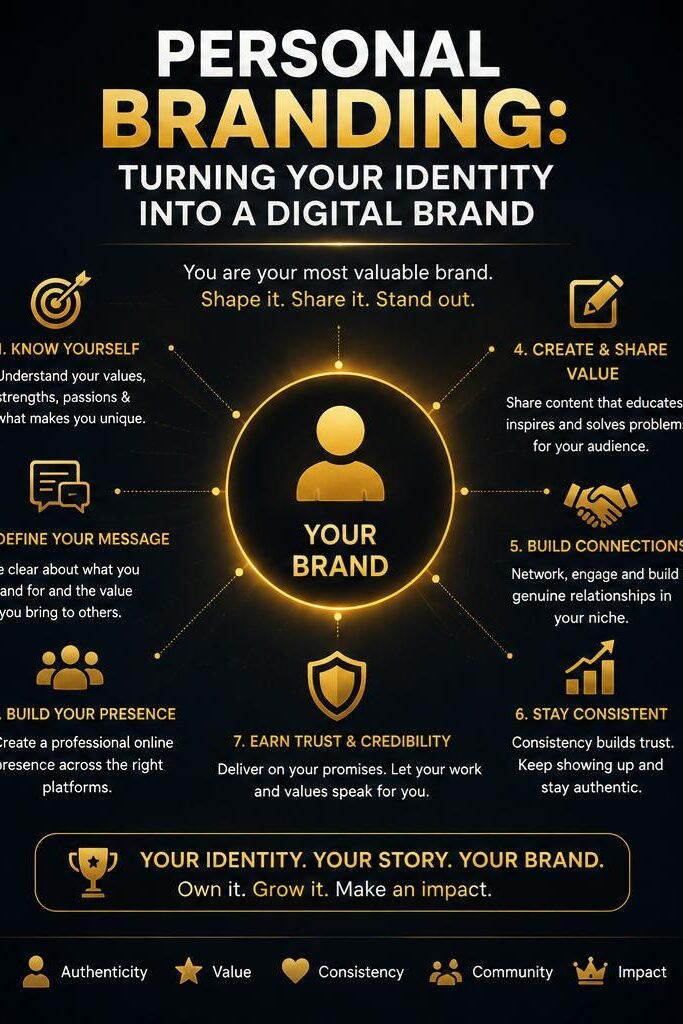
In today’s digital world, people are not only building businesses—they are also building themselves as brands.
When someone searches your name online, what do they see?
Your social media profile, LinkedIn account, portfolio, projects, achievements, skills, and the content you share can all influence how people understand you.
This is where Personal Branding becomes important.
Personal branding is the process of presenting your skills, knowledge, personality, values, and experiences in a clear and consistent way.
It is not about pretending to be someone else.
It is about showing the world who you are, what you know, what you can do, and what makes you different.
In a competitive digital environment, a strong personal brand can help students, professionals, freelancers, creators, entrepreneurs, and job seekers build credibility and create opportunities.
What Is Personal Branding?
Personal branding is the way you intentionally communicate your identity and professional value to other people.
A personal brand can include:
- Your skills
- Your knowledge
- Your interests
- Your achievements
- Your communication style
- Your work
- Your values
- Your online presence
- Your professional reputation
Think of your personal brand as your digital identity.
Your resume may show what you have done, but your personal brand can show how you think, what you care about, and what you can contribute.
Why Personal Branding Matters
The internet has made it easier than ever for people to discover information about professionals.
Recruiters may search for candidates online.
Clients may research freelancers before contacting them.
Businesses may look at creators before collaborating.
People may check social media profiles before trusting someone.
Because of this, your online presence can become an extension of your professional identity.
A strong personal brand can help you:
| Benefit | How It Helps |
|---|---|
| Visibility | Helps people discover you |
| Credibility | Demonstrates your knowledge |
| Networking | Creates professional connections |
| Opportunities | Can attract projects and collaborations |
| Differentiation | Helps you stand out |
| Trust | Builds a consistent professional image |
Personal branding is therefore not only about popularity.
It is about being recognized for something valuable.
Personal Brand vs Personal Image
These two ideas are related, but they are not exactly the same.
Your personal image is how people currently perceive you.
Your personal brand is how you intentionally communicate your identity and professional value.
For example, someone may be interested in digital marketing but have no clear online presence.
Another person may regularly share useful digital marketing content, showcase projects, and explain what they are learning.
Both may have similar knowledge.
But the second person has made that knowledge more visible.
This is one of the main purposes of personal branding.
The Foundation of a Strong Personal Brand
A strong personal brand begins with self-understanding.
Before asking, “What should I post?”, ask:
Who am I?
What am I good at?
What do I enjoy learning?
What problems can I help solve?
What do I want to be known for?
These questions help you create a clearer direction.
Personal Branding Formula
Identity + Skills + Value + Consistency = Personal Brand
Your identity makes your brand personal.
Your skills demonstrate what you can do.
Your value explains why people should pay attention.
Consistency helps people remember you.
Finding Your Niche
A niche is a specific area that you want to focus on.
Instead of trying to become known for everything, choosing a clear area can make your personal brand easier to understand.
For example:
- Digital Marketing
- SEO
- Social Media
- Graphic Design
- Photography
- Web Development
- Content Creation
- Business
- Education
- Technology
You do not have to know everything about your niche from the beginning.
You can build your personal brand while learning.
For students especially, sharing the learning journey can itself become valuable content.
Building Your Unique Value
One important question is:
“What makes me different?”
Being different does not necessarily mean having a completely unique skill.
Your uniqueness can come from the way you combine your skills, interests, experiences, and personality.
For example:
A person may combine digital marketing + graphic design.
Another may combine SEO + content writing.
Someone else may combine social media + video editing.
These combinations can create a distinctive professional identity.
Your personal brand should communicate what you can offer rather than simply listing everything you know.
Choosing the Right Platforms
You do not need to be active on every social media platform.
Different platforms can serve different purposes.
| Platform | Useful For |
|---|---|
| Professional networking | |
| Visual content and personal storytelling | |
| YouTube | Long-form video and education |
| Communities and general content | |
| Personal Website | Portfolio and professional identity |
Choose platforms based on your goals and where your audience is likely to be.
A strong presence on two platforms is often more useful than an inactive presence on ten.
Creating a Professional Online Profile
Your profile is often the first impression people receive.
A professional profile should clearly communicate:
Who you are + What you do + What you are interested in
Important elements can include:
- Clear profile photo
- Simple username
- Professional bio
- Relevant skills
- Portfolio link
- Contact information where appropriate
- Consistent visual identity
Your profile should be easy to understand.
Someone visiting your page should not have to guess what you are interested in.
Content Is the Voice of Your Personal Brand
If your profile is your digital identity, your content is your voice.
Content allows people to understand your knowledge and perspective.
You can create content around four major categories:
1. Educational Content
Share useful information, tips, tutorials, and explanations.
2. Experience-Based Content
Talk about projects, lessons, challenges, and things you have learned.
3. Inspirational Content
Share ideas and experiences that can motivate or encourage others.
4. Personal Perspective
Share your opinions and observations about your field in a thoughtful way.
The objective is not to post constantly.
The objective is to provide value consistently.
The Power of Storytelling
People connect with stories.
Instead of simply saying:
“I am learning digital marketing.”
you could explain what interested you in digital marketing, what you have learned, what challenges you faced, and what you want to learn next.
This creates a more human connection.
A personal brand should feel like a person—not a corporate advertisement.
Consistency Is More Important Than Perfection
One of the biggest mistakes people make is waiting for everything to become perfect before they start.
Your first post may not be your best post.
Your first portfolio may not be your strongest portfolio.
Your first video may not receive many views.
That is normal.
Personal branding grows through continuous improvement.
A simple process is:
Create → Publish → Learn → Improve → Repeat
Consistency allows your audience to see your development over time.
Building Trust
A personal brand becomes valuable when people trust it.
Trust can be built through:
- Honest communication
- Useful content
- Consistent activity
- Demonstrated skills
- Real projects
- Professional behavior
- Authentic experiences
Do not claim to be an expert in everything.
If you are learning something, you can say you are learning it.
Sharing your progress can make your brand more authentic.
Personal Branding for Students
Students do not need years of experience to start building a personal brand.
In fact, starting early can be useful.
Students can share:
- Courses they are completing
- Projects they create
- Skills they are learning
- Industry knowledge
- Certifications
- Portfolio work
- Lessons from practice
Instead of waiting until graduation to build an online presence, students can gradually create a professional identity while developing their skills.
For example:
Learning → Practicing → Creating → Sharing → Building a Portfolio
This process can help demonstrate growth over time.
Personal Branding and Digital Marketing
Personal branding and digital marketing are closely connected.
Digital marketing promotes a business or product.
Personal branding promotes your professional identity.
However, many of the same strategies can be applied.
| Digital Marketing | Personal Branding |
|---|---|
| Target audience | Professional audience |
| Brand identity | Personal identity |
| Content strategy | Personal content |
| Social media marketing | Professional presence |
| SEO | Name and profile visibility |
| Website | Portfolio/personal website |
| Analytics | Content performance |
Understanding digital marketing can therefore help you build a stronger personal brand.
The Role of a Personal Website
A personal website can become the central home of your professional identity.
It can include:
About Me
A short introduction about who you are.
Skills
The skills you are developing or have experience with.
Portfolio
Projects and examples of your work.
Blog
Articles that demonstrate your knowledge.
Contact
A simple way for professional opportunities to reach you.
A website gives you more control over how your professional identity is presented.
Common Personal Branding Mistakes
Personal branding can become ineffective when people focus on the wrong things.
Trying to Copy Others
Learn from successful creators, but develop your own identity.
Posting Without Purpose
Every piece of content does not need to be promotional, but it should have a reason.
Being Inconsistent
Posting once and disappearing for months makes it difficult to build recognition.
Focusing Only on Followers
A large follower count does not automatically mean a strong professional reputation.
Pretending to Know Everything
Authenticity is more valuable than pretending to be perfect.
Ignoring Your Portfolio
Your content can attract attention, but your work can demonstrate your ability.
Measuring Your Personal Brand
Personal branding can also be evaluated.
Instead of focusing only on follower numbers, look at meaningful indicators.
| Metric | What It Can Tell You |
|---|---|
| Profile Views | How many people are discovering you |
| Engagement | Whether people interact with your content |
| Website Visits | Interest in your professional work |
| Portfolio Views | Interest in your projects |
| Connections | Growth of your professional network |
| Enquiries | Potential opportunities generated |
The goal is not to chase numbers.
The goal is to understand whether your online presence is moving toward your professional objectives.
The Future of Personal Branding
The importance of personal branding will continue to grow as more professional activity moves online.
Artificial intelligence is making it easier to create content, but this also means originality and authenticity will become increasingly valuable.
When everyone can generate similar content, your personal experiences, perspective, creativity, and real work can help differentiate you.
The future of personal branding is therefore not simply about creating more content.
It is about creating more meaningful content.
A Simple Personal Branding Roadmap
You can start with a simple five-step process:
Step 1 — Discover
Identify your skills, interests, strengths, and goals.
Step 2 — Define
Choose the area you want to become known for.
Step 3 — Build
Create professional profiles and a portfolio.
Step 4 — Share
Publish useful content consistently.
Step 5 — Improve
Study feedback, learn new skills, and refine your online presence.
This process does not need to happen overnight.
A strong personal brand is built gradually.
Conclusion
Personal branding is not about becoming famous.
It is about becoming recognizable, credible, and valuable in your chosen field.
In a world where people search online before making decisions, your digital identity can influence how others perceive your skills and potential.
Your profile introduces you.
Your content communicates your ideas.
Your portfolio demonstrates your abilities.
Your consistency builds recognition.
Your authenticity builds trust.
The most powerful personal brand is not the one that looks perfect.
It is the one that feels real, useful, consistent, and memorable.
Your name is already a brand.
The real question is: