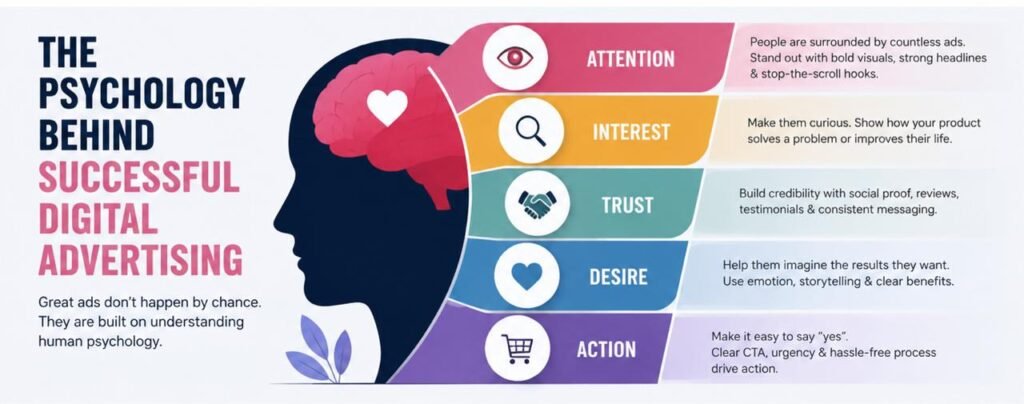
Introduction
Every day, people see hundreds of advertisements while browsing websites, scrolling through social media, watching videos, or searching online. Some advertisements are immediately forgotten, while others stay in our minds.
Have you ever wondered why?
The answer is not always the product itself. Often, it is psychology.
Successful digital advertising helps businesses reach the right audience and archieve better marketing results
Digital advertising combines creativity, technology, data, and human psychology. When these elements work together, an ordinary advertisement can become a powerful communication tool.
This blog explores the psychology behind successful digital advertising and explains how marketers use psychological principles to create advertisements that connect with audiences.
What Is Successful Digital Advertising?
Digital advertising is the promotion of products, services, or brands through digital platforms.
Advertisements can appear on:
- Search engines
- Social media
- Websites
- Video platforms
- Mobile applications
- Online marketplaces
- Email platforms
Unlike traditional advertising, digital advertising allows marketers to reach specific audiences and measure how people interact with advertisements.
But targeting the right audience is only one part of the process.
The advertisement must also capture attention, create interest, communicate value, and encourage an appropriate action.
That is where psychology becomes important.
Why Psychology Matters in Successful Digital Advertising
People do not always make decisions based entirely on logic.
Emotions, experiences, habits, social influences, expectations, and personal needs can all influence decisions.
For example, two advertisements may promote exactly the same product. One may receive very little attention, while the other may generate strong engagement.
The difference could be the way the message is presented.
A successful advertisement understands that behind every screen is a real person with different needs, interests, emotions, and experiences.
Therefore, effective advertising begins with a simple question:
“What matters to my audience?”
1. The Psychology of Attention
The first challenge of digital advertising is getting attention.
People scroll quickly through social media feeds and browse websites filled with information. Advertisers have only a short opportunity to make someone notice their message.
This is why the visual and opening message of an advertisement is important.
Strong headlines, interesting visuals, clear designs, questions, and relevant messages can help capture attention.
For example, instead of simply saying:
“We offer digital marketing services.”
an advertisement could focus on a problem:
“Is your business struggling to get noticed online?”
The second message immediately speaks to a possible problem.
The key idea is:
Before you can communicate value, you need to earn attention.
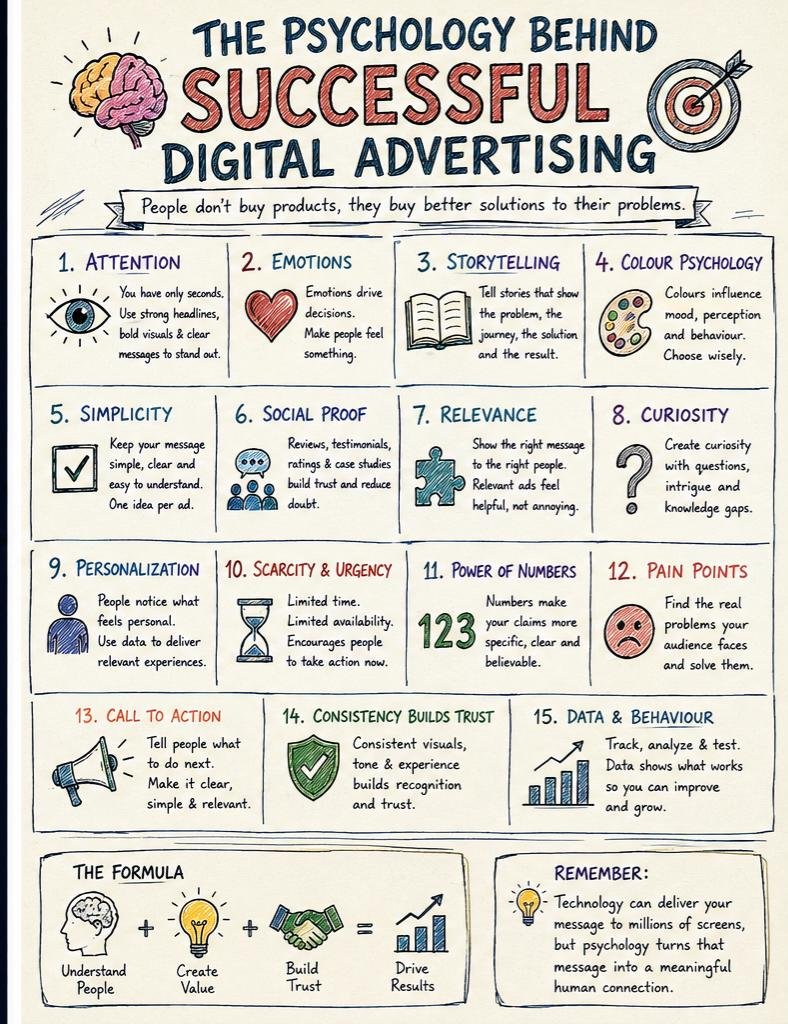
2. Emotions Influence Decisions
One of the strongest psychological elements in advertising is emotion.
People can respond to advertisements because they feel happy, curious, excited, inspired, understood, or hopeful.
This does not mean advertisements should manipulate emotions.
Instead, effective advertising connects a product or service with a meaningful human need.
For example, a travel advertisement may focus on adventure and memorable experiences rather than simply showing a hotel room.
A learning platform may focus on confidence and personal growth rather than only listing course features.
The product is still important, but the emotional meaning surrounding it can make the message more memorable.
3. The Power of Storytelling
Stories are easier for people to connect with than a collection of facts.
This is why storytelling has become an important part of digital advertising.
A simple advertising story can follow a structure such as:
Problem → Journey → Solution → Result
For example, imagine a small business struggling to attract customers online.
The advertisement introduces the challenge, shows the process of improving its digital presence, and explains how the business developed a stronger connection with its audience.
The story gives context to the product or service.
Instead of simply saying “Our service is good,” the brand demonstrates how its service can fit into a real situation.
4. Colour Psychology
Colour can influence how people perceive visual communication.
Different colours can create different impressions.
For example:
- Blue can communicate professionalism and reliability.
- Green is often associated with nature, freshness, or growth.
- Yellow can create a bright and energetic feeling.
- Black can communicate sophistication or strength.
- Orange can feel energetic and friendly.
However, colour meanings are not universal rules.
Cultural context, industry, design style, and personal experiences also influence how colours are perceived.
Therefore, marketers should choose colours based on the brand identity and the message they want to communicate.
5. The Importance of Simplicity
People do not want to spend a long time trying to understand an advertisement.
If an advertisement contains too much text, too many visual elements, or an unclear message, people may simply scroll past it.
A strong advertisement usually communicates one clear idea.
Instead of trying to explain everything in one advertisement, marketers can focus on one specific message.
For example:
Problem: Your website gets visitors but few enquiries.
Message: Turn website visitors into potential customers.
Action: Learn how.
Simple communication makes the advertisement easier to understand.
6. Social Proof and Trust
People often look at the experiences of others before making decisions.
This is known as social proof.
Customer reviews, testimonials, ratings, case studies, user-generated content, and genuine experiences can help establish credibility.
For example, when choosing between two unfamiliar services, a person may feel more comfortable exploring the one with authentic positive customer feedback.
Social proof works because people often use other people’s experiences as one source of information when evaluating unfamiliar choices.
However, trust depends on authenticity.
Fake reviews or misleading claims can damage a brand’s reputation.
7. The Principle of Relevance
An advertisement becomes more effective when it feels relevant to the person seeing it.
Imagine someone is interested in learning photography and repeatedly receives advertisements for unrelated products.
They are unlikely to pay attention.
But if they see an advertisement about photography courses, editing tools, or camera accessories, the message may feel more relevant.
Digital advertising platforms can use audience signals and campaign settings to help advertisers reach people who may be interested in particular topics.
Relevance helps reduce unnecessary advertising and can improve the overall user experience.
8. The Psychology of Curiosity
Curiosity can encourage people to learn more.
An advertisement does not always need to reveal everything immediately.
A thoughtful question or intriguing statement can encourage someone to continue reading or explore further.
For example:
“Why are some websites getting more customers with the same amount of traffic?”
This creates a knowledge gap.
The audience may want to discover the answer.
However, curiosity should be honest. An advertisement should not promise something it cannot deliver simply to generate clicks.
9. The Role of Personalization
People are more likely to notice communication that feels relevant to their interests.
Personalization can include appropriate audience targeting, relevant content, useful recommendations, or messages based on previous interactions.
For example, an online store may show products related to a person’s browsing activity.
Personalization can improve relevance when it is transparent, respectful, and based on appropriate data practices.
The goal should be to make communication more useful—not uncomfortable.
10. Scarcity and Urgency
Scarcity and urgency are commonly used psychological principles in advertising.
Messages such as limited-time offers or event deadlines can encourage people to make decisions rather than postponing them.
For example:
“Registration closes Friday.”
This communicates a genuine deadline.
However, marketers should use urgency responsibly.
Artificially creating pressure or making false scarcity claims can reduce trust.
Good advertising creates urgency through real information, not deception.
11. The Power of Numbers
Numbers can make advertising messages more specific.
Compare:
“Many businesses trust our service.”
with:
“More than 500 businesses have used our service.”
The second statement provides a specific claim that can be evaluated.
Numbers can be useful when they are accurate, relevant, and presented honestly.
Statistics, percentages, customer counts, and measurable results can make communication clearer.
12. Understanding Pain Points
Successful advertising often begins with understanding a customer’s problem.
A pain point is a challenge, difficulty, or unmet need experienced by the target audience.
For example:
A student may struggle to find practical learning resources.
A small business may struggle to generate online enquiries.
A customer may find it difficult to compare different services.
An effective advertisement identifies the problem and clearly explains how the product or service can help.
This creates a simple communication structure:
Understand the problem → Present the solution → Explain the value.
13. The Importance of the Call to Action
An advertisement should make it clear what the audience can do next.
This is called a Call to Action, or CTA.
Examples include:
- Learn More
- Explore Now
- Sign Up
- Contact Us
- Get Started
- Read the Guide
- Request Information
The CTA should match the purpose of the advertisement.
A person who is seeing a brand for the first time may need an informational action rather than an immediate purchase request.
The right CTA guides the audience without creating unnecessary pressure.
14. Building Trust Through Consistency
Trust is not created by one advertisement.
It develops through repeated experiences.
If a brand uses consistent visuals, communication, information, and customer experiences across different digital platforms, people can develop stronger recognition.
Consistency can include:
- Brand colours
- Logo
- Typography
- Tone of voice
- Visual style
- Quality of content
- Customer communication
A consistent brand feels more recognizable and professional.
15. Data and Consumer Behaviour
Psychology helps marketers understand why people respond.
Data helps marketers understand what actually happened.
Digital advertising can provide information about impressions, clicks, engagement, conversions, and other campaign metrics.
Marketers can use this information to test different ideas.
For example, they may compare two versions of an advertisement:
Version A: Product-focused message
Version B: Problem-focused message
If one performs better, the marketer can study the results and use the learning to improve future campaigns.
This creates a continuous process:
Test → Measure → Learn → Improve.
Ethical Psychology in Successful Digital Advertising
Understanding psychology gives marketers significant influence.
That influence should be used responsibly.
Good advertising should not depend on fear, deception, fake scarcity, misleading claims, or exploitation of vulnerable people.
Ethical advertising respects the audience.
It provides accurate information, protects privacy, communicates clearly, and allows people to make informed decisions.
The goal should be persuasion through value and relevance, not manipulation.
The Future of Psychological Successful Digital Advertising
As digital technology develops, advertising will become increasingly data-driven and personalized.
Artificial intelligence can help marketers analyze large amounts of information, identify patterns, create variations of content, and improve campaign strategies.
At the same time, audiences are becoming more aware of advertising techniques.
People can recognize overly promotional content quickly.
This means authenticity will become even more important.
Future advertising will need to combine:
Technology + Data + Creativity + Psychology + Trust
Brands that understand this combination can create stronger digital experiences.
Conclusion
Successful digital advertising is not simply about creating a beautiful poster or spending money on an advertisement.
It is about understanding people.
Why do they stop scrolling?
What makes them curious?
What creates trust?
What problems are they trying to solve?
What information helps them make a decision?
Psychology helps marketers answer these questions.
Attention brings people to the message.
Emotion makes the message meaningful.
Storytelling makes it memorable.
Relevance makes it useful.
Social proof can strengthen trust.
A clear call to action provides direction.
Data helps marketers learn what works.
When all these elements come together, advertising becomes more than promotion.
It becomes communication.
And the most successful digital advertisements are not necessarily the loudest ones.
They are the ones that make people feel understood, discover value, and remember the brand.
In the digital world, technology can deliver a message to millions of screens—but psychology helps turn that message into a meaningful human connection.